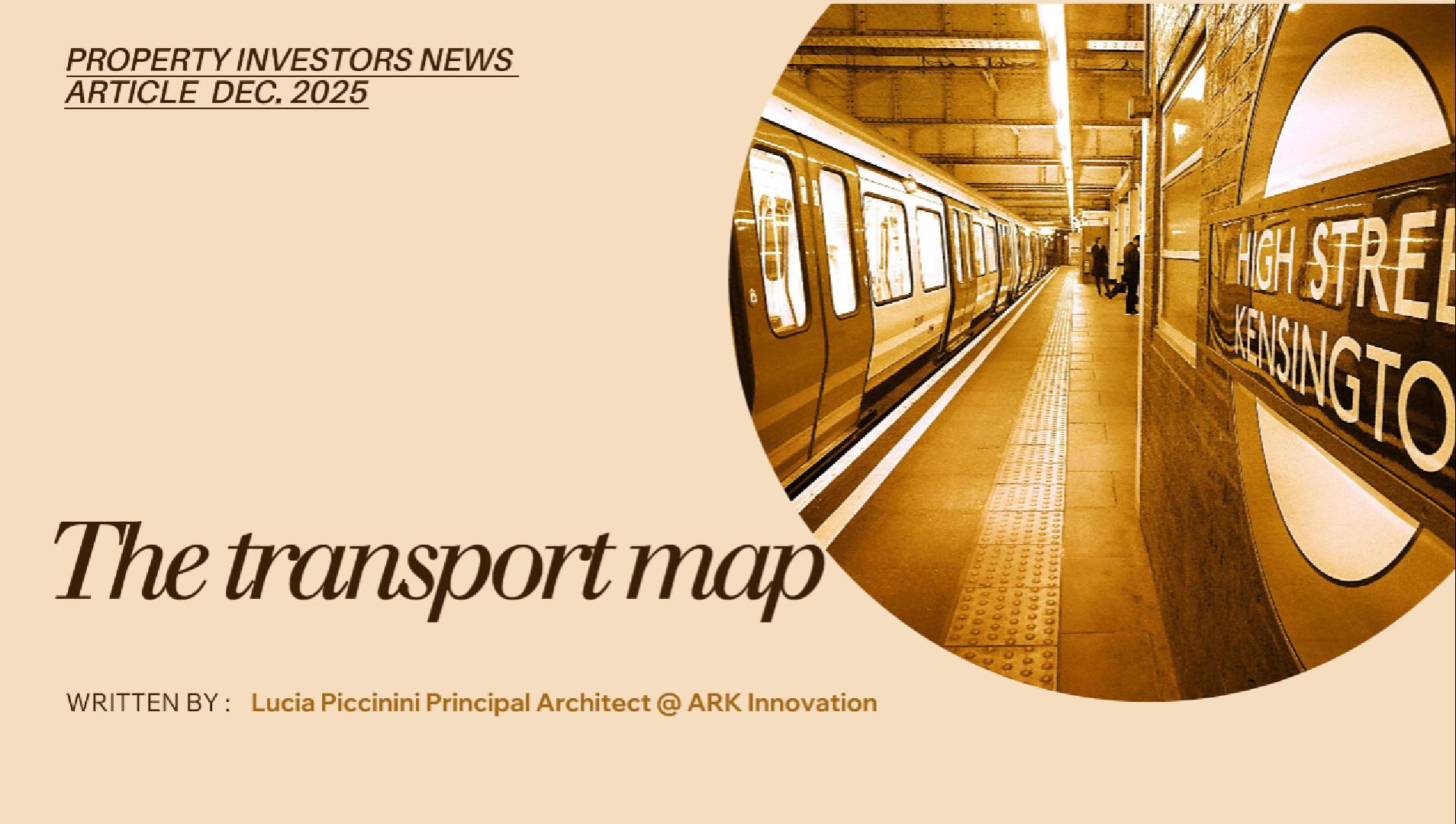
Understanding the Link Between Infrastructure, Density and Resilient Property Investment
The Transport Wealth Strategy: Why Rail, Tube & DLR Corridors Drive Long-Term Property Value
Lucia Piccinini has been invited to contribute to Property Investor News, a UK magazine for professional landlords, developers and finance professionals, known for evidence-led market analysis and practical case studies.
What if the most effective property investment strategy in London was not about timing the market, predicting interest rates or chasing the next emerging postcode, but understanding the transport network?
Across the capital, rail, Tube and DLR corridors shape where people live, work and invest. Improved connectivity influences land values, planning policy, housing demand and long-term development potential.
For developers, investors and architects, understanding transport-led growth is becoming essential. The ability to identify undervalued locations before the wider market reacts can generate significant long-term return on investment while reducing planning risk and improving project viability.
This article explores how transport infrastructure, planning policy and design quality work together to shape the future of development across London.
Transport Infrastructure Drives Land Value
Rail, Underground and DLR networks do far more than move people across the city. They act as long-term economic drivers, influencing density, commercial activity and residential demand.
When a neighbourhood gains faster and more reliable connections to major employment centres such as Canary Wharf, the City or Heathrow, land values typically increase.
For developers, improved connectivity can unlock new opportunities for higher-density development, mixed-use schemes, office-to-residential conversions and airspace extensions.
Transport infrastructure also supports car-light and car-free development models, aligning with London’s wider sustainability objectives and reducing planning friction.
Planning Policy Favours Transit-Oriented Development
Planning policy across London increasingly supports Transit-Oriented Development (TOD), encouraging growth around well-connected transport hubs.
The London Plan and local borough strategies frequently promote:
Higher-density development near stations
Mixed-use intensification
Car-free or car-light schemes
Sustainable mobility infrastructure
Regeneration of underutilised urban land
For developers and investors, aligning proposals with these planning objectives can significantly improve the likelihood of approval and reduce negotiation times.
Areas with strong PTAL ratings often provide opportunities for residential intensification, height increases, mixed-use regeneration and conversion projects.
When transport infrastructure, planning policy and architecture align, development potential increases substantially.
Identifying Undervalued Locations Before the Market Reacts
One of the most effective development strategies is identifying locations where transport connectivity and planning support are already in place, but market values have yet to respond.
Early opportunities frequently emerge in underutilised sites near stations, ageing retail parades, industrial edges and low-density areas adjacent to established growth locations.
By understanding future accessibility improvements and planning priorities, developers can identify sites with significant long-term value potential.
Design Quality Must Match Connectivity
Connectivity alone is no longer enough.
High-accessibility locations increasingly demand higher standards of architecture, sustainability and placemaking.
Developments near major transport corridors must carefully address:
Acoustic insulation
Overheating prevention
Daylight optimisation
Energy efficiency
Biodiversity requirements
Public realm enhancement
Well-designed mixed-use developments with active ground floors, landscaped communal spaces and sustainable systems generally achieve stronger long-term performance, both financially and socially.
Architecture near transport hubs is not about building more. It is about building better.
Conclusion – Heritage as Opportunity
Mixed-Use Development Creates Long-Term Value
Why Case Studies Matter and Why to Subscribe to Property Investor News
Reading rigorous case studies is one of the fastest ways for investors to build real-world judgment. They reveal the full stack—context, constraints, numbers, design choices, approvals, risks—so you can recognise patterns, benchmark assumptions and avoid common execution errors. Case studies also sharpen “what if?” thinking: which levers actually move GDV, which upgrades lift EPC at least cost, and how phasing de-risks cash flow. Property Investor News consistently publishes data-led case studies, market analysis and policy updates tailored to active landlords and developers. For investors who want evidence over anecdotes, subscribing ensures a steady flow of actionable insight you can apply on your next appraisal—before capital is committed.
Special Thanks
Heartfelt thanks to Property Investor News and Ross P Bowser for the invitation to contribute and for their thoughtful editorial guidance. Their commitment to clear, evidence-led reporting creates a valuable platform for serious landlords, developers, and finance professionals.
Property Investor News consistently elevates the conversation with rigorous case studies, market analysis, and policy insight—exactly the kind of practical intelligence investors need to make better, faster decisions. I’m grateful for the opportunity to share learnings with their readership and to contribute to that mission.
As a RIBA Chartered Practice, we work closely with private clients, property developers, and commercial partners—guiding them from concept to completion with innovative, tailored architectural solutions that bring their visions to life.